
houtini-ai/seo-audit
Developer toolsFree SEO Audit MCP server for Claude - captures and stores all the raw data you need for a complete technical SEO audit.
Overview
Almost every technical SEO audit I've been handed in twenty years is a crawler's opinion, and a crawler only ever sees half the picture. It tells you what your site says. It has nothing to say about what Google did about it: which queries you rank for, which pages earn the impressions, where the clicks land. This one brings the other half. SEO Audit Console runs inside Claude, pulls your history, crawls your site properly, and joins the two so every finding carries the traffic at stake. A hundred and eleven checks, ranked by the clicks the fix could recover rather than how alarming the check sounds, and it writes the fix for you: the 301 rule, the JSON-LD, the internal links. The core audit needs nothing but your own Search Console; and slot in later, when your questions grow into competitors and link building. Your data stays on your machine.
README
SEO Audit Console - the technical SEO audit MCP server for Claude
A technical SEO audit you can hold a conversation with - built from your own Search Console data and a live crawl of your site, run inside Claude.




Almost every technical SEO audit I’ve been handed in twenty years is a crawler’s opinion, and a crawler only ever sees half the picture. It tells you what your site says. It has nothing to say about what Google did about it: which queries you rank for, which pages earn the impressions, where the clicks land.
This one brings the other half. SEO Audit Console runs inside Claude, pulls your Google Search Console history, crawls your site properly, and joins the two so every finding carries the traffic at stake. A hundred and eleven checks, ranked by the clicks the fix could recover rather than how alarming the check sounds, and it writes the fix for you: the 301 rule, the JSON-LD, the internal links. The core audit needs nothing but your own Search Console; DataForSEO and Majestic slot in later, when your questions grow into competitors and link building. Your data stays on your machine.
Built by Houtini. We build automation for the grunt work of digital marketing - the data collection, the crawling, the merging, the checking - so your team’s time goes on the thinking, the strategy and the client work that needs a human. This plugin is that idea applied to the technical SEO audit.
New to MCPs, or not sure where to start? The Getting started guide takes you from a completely fresh machine (no Node, no Git, never heard of a service account) to your first audit - every step screenshotted, including the one everyone misses. Ten minutes, honestly.
you  › run an SEO audit on mysite.com

     ⣾ search console  1.8M rows synced (19s - incremental)
     ⣾ crawl           868 pages · HTTP/2 · robots-polite · 8 parallel
     ⣾ link graph      internal PageRank · click depth · in-degree
     ✓ 143 checks · 220 findings · ranked by expected clicks per dev-hour

     #1  CTR far below position-expected     /pricing                   XL
     #2  Page losing clicks (trend)          site-wide                  XL
     #3  Keyword cannibalisation             "project management app"   L
     #4  Robots-blocked page earning traffic /category/guides           L

you  › generate the fix for #1 ▍
Quick start
It’s on npm, so there’s nothing to clone or build. You need Node.js 20 or newer and a Search Console property you own.
Claude Desktop - add this to claude_desktop_config.json, then restart Claude:
{
  "mcpServers": {
    "seo-audit-console": {
      "command": "npx",
      "args": ["-y", "@houtini/seo-audit-console"],
      "env": {
        "GOOGLE_APPLICATION_CREDENTIALS": "C:/path/to/service-account.json",
        "DATAFORSEO_USERNAME": "",
        "DATAFORSEO_PASSWORD": "",
        "MAJESTIC_API_KEY": "",
        "CRUX_API_KEY": ""
      }
    }
  }
}
The first line is required. The others are optional: paste your key between the quotes, or leave them empty to switch the tier off. DataForSEO and Majestic are paid tiers; CRUX_API_KEY is field Core Web Vitals from a free Google API key restricted to the Chrome UX Report API. Empty means off. Template text such as your-key-here, `` or changeme is treated as empty too, and the server’s log says so in one line (e.g. MAJESTIC_API_KEY looks like a placeholder; Majestic tier disabled.), so a tier you expected that stays off is worth a look at the log.
Claude Code - one command (add --env DATAFORSEO_USERNAME=… and the others the same way if you use them):
claude mcp add seo-audit-console --env GOOGLE_APPLICATION_CREDENTIALS=C:/path/to/service-account.json -- npx -y @houtini/seo-audit-console
GOOGLE_APPLICATION_CREDENTIALS alone is the whole core audit. The step everyone misses: the JSON key belongs to a Google Cloud service account, and that account’s email has to be added as a user on your property in Search Console, or the tool can’t see any of your data. Getting started walks through it with screenshots, plus the one-click Claude Desktop extension and the build-from-source route.
Then ask Claude: “list properties”, “refresh mysite.com”, “run an SEO audit”.
Opening the dashboard
Once a property has been refreshed or audited, there are three ways to see it:
| You want | Ask Claude | What you get |
|---|---|---|
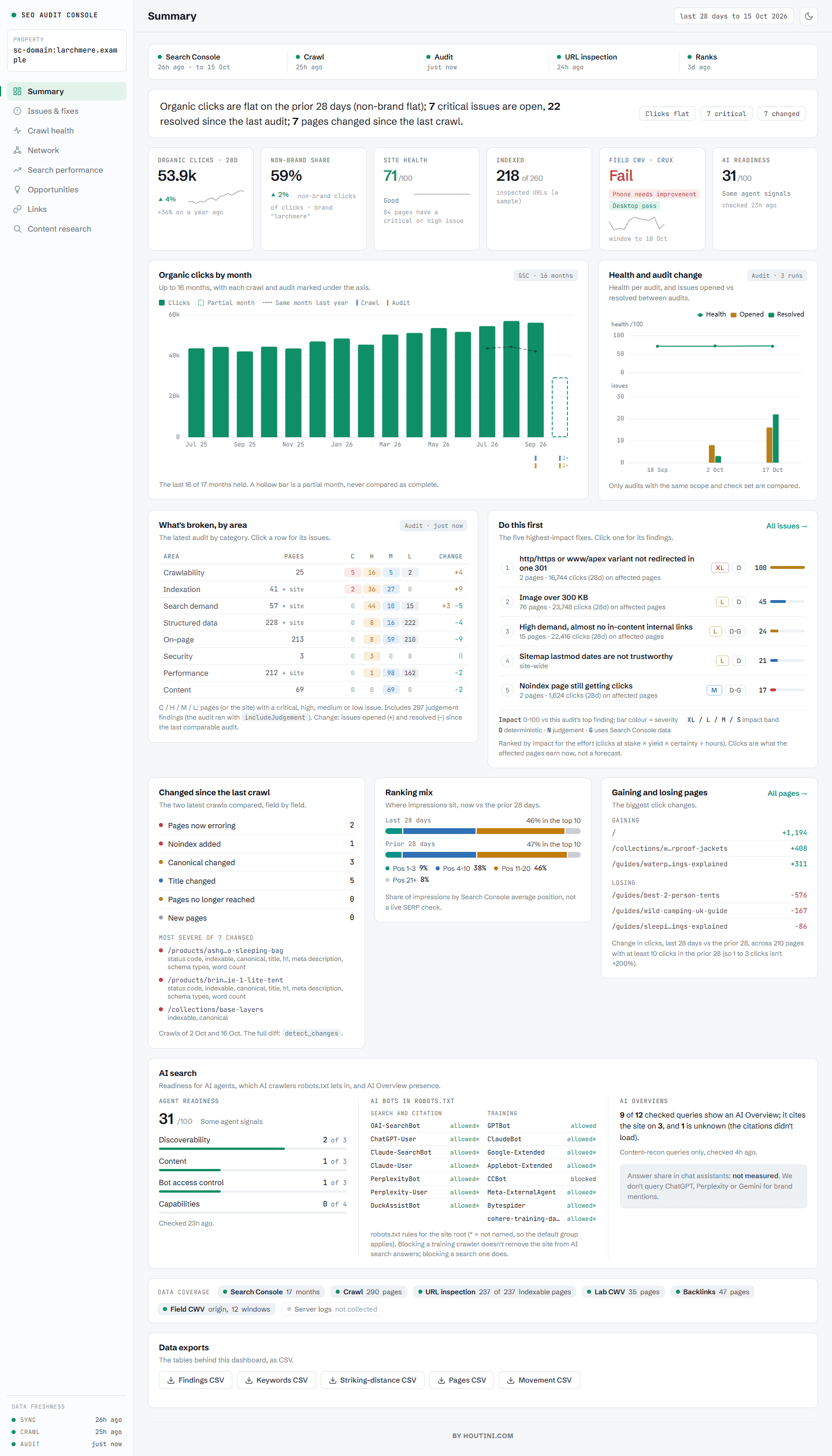
| A quick look in the chat | “show me the dashboard for mysite.com” | The dashboard drawn inside the conversation (get_dashboard) |
| The full dashboard in your browser | “open the dashboard for mysite.com” | A link such as http://127.0.0.1:53817/dashboard?siteUrl=… (open_dashboard). Click it. It reads the local database live, so reload after each refresh |
| Something to send a client | “export the report for mysite.com” | One self-contained HTML file (export_report) |
You often don’t need to ask: when a refresh, crawl, sync or audit finishes, the reply says the dashboard is updated and includes the browser link. The link is local to your machine (it only answers on 127.0.0.1), and the port changes each time the server starts, so use the link from the latest reply. Add &theme=dark for dark mode, or &redact=1 to blur the numbers for a screenshot.
Running it under Docker or the Docker MCP gateway? The browser link points at a port inside the container, which your browser can’t reach. Run the dashboard as its own small container on a fixed port instead, on the same data volume:
docker run -d --name seo-audit-dashboard --restart unless-stopped -p 127.0.0.1:8788:8788 -e SAC_DATA_DIR=/data -e SAC_DASHBOARD_BIND=0.0.0.0 -e SAC_DASHBOARD_PORT=8788 -v seo-audit-data:/data node:22-slim npx -y -p @houtini/seo-audit-console seo-audit-dashboard
Then open http://127.0.0.1:8788/dashboard?siteUrl=sc-domain:mysite.com. Use the volume name your MCP server writes to. In Git Bash on Windows, put MSYS_NO_PATHCONV=1 in front of the command so /data isn’t rewritten as a Windows path. More in dashboard.md.
The manual
This README is the story and the quick start. The detail lives in the manual:
| Page | What’s in it |
|---|---|
| Getting started | Install, the GSC service-account setup (and the step everyone misses), Claude Desktop and Claude Code config, your first audit, troubleshooting |
| Tool reference | Every tool: what it does, inputs, joins, an example prompt |
| The check registry | All 143 checks with what each catches, its D/N label, and the fix |
| Composition | The join keys, the grains, and fourteen recipes for asking your own questions across the data |
| Competitive analysis | The Semrush-replacement workflows, DataForSEO setup, link intersect with the Majestic Trust Flow tier, and the real costs |
| SEO Recon | Why a page is losing: the live SERP + AI-Overview citation verdict, the competitor diff, and the trackable to-do ledger |
| DataForSEO functions | Every DataForSEO-backed tool grouped by API module - Keywords, SERP, Labs, Backlinks, OnPage - each with its endpoint and cost |
| Majestic functions | The optional Trust Flow tier - what it adds, and how link_intersect and pull_backlinks use it |
| Dashboard & reports | The eight tabs, what each chart shows, the browser dashboard (and its standalone version for Docker), and the shareable export |
Surprisingly little has changed in twenty years
The technical audit I was writing for clients in 2006 is, structurally, the audit most agencies still sell today. A crawler runs, a template fills, a 60-page PDF lands. Everything a crawler could find, in severity order, with no idea which findings are worth money and which are cosmetic.
What has changed is what’s possible. Google gives every site owner a complete record of its search reality - which queries, which pages, how many impressions, where you ranked. Your crawl tells you what your site says. Search Console tells you what Google did about it. And in my experience, the gap between those two datasets is where nearly all of the recoverable traffic hides.
So that’s what I built. SEO Audit Console is a Model Context Protocol server that merges your Search Console history with a first-party crawl of your site (and, when you want it, DataForSEO) into one thing: a prioritised, evidence-backed audit you can interrogate inside Claude Desktop. It hands you paste-ready fixes. Every finding traces back to a real datapoint.
One idea underneath all of it:
Your crawl is intent. Search Console is reality. The money is where they diverge.
A flat crawler tells you a page 404s. Useful, but only just. This tells you the 404 is draining 15% of your homepage’s internal PageRank, that the page used to earn 10,000 clicks a month, and it writes the 301 rule to fix it. It finds the page at position #3 on 150,000 impressions with a 0.2% click-through rate - a title rewrite probably worth thousands of clicks - and ranks that above the cosmetic findings. Severity is what crawlers sell you. Yield is what moves the numbers.
Who is this for?
The SEO consultant who wants the collection and checking automated so the thinking time survives. The in-house marketer who’s been quoted four figures for a commodity audit. And anyone newer to this who wants to learn what a good audit looks at - because every finding shows its evidence, the tool doubles as a teacher.
A note on where to run it. Claude Desktop is the easy start, but in my view Claude Code is the best home for this tool - because it closes the loop. In a chat client the audit hands you a 301 rule to paste somewhere. In Claude Code, the same session has your site’s repo, a terminal and git: the audit finds the issue, writes the fix, applies it to the codebase, commits it, and re-crawls to verify. Finding to deployed fix, one conversation.
You don’t need to learn an interface. You type “run an SEO audit on mysite.com” into Claude and it happens. Forget what’s possible? Ask “run seo_audit_help” and you get the full menu with example prompts.
Does the approach work?
Yes. The crawl-plus-GSC merge is not a novelty; it’s the method. On one property, seeding the crawl from Search Console URLs took coverage of GSC-known pages from 29% to 70% - every one of those extra pages is a page a conventional crawl silently missed, and several were earning traffic with no internal links pointing at them at all. On the same property the incremental sync turned a 33-minute data refresh into 19 seconds, which is the difference between “audit quarterly” and “audit whenever you’re curious”.
What the audit checks
run_audit executes 143 checks over the joined data and returns a ranked list - not a wall of everything, a priority order with the traffic at stake attached to each finding. The families, briefly:
| Family | What it catches |
|---|---|
| Crawlability & indexation | Broken links, redirect hygiene (chains, loops, temporary redirects carrying equity, redirects onto non-indexable pages or the homepage, live pages removed without a redirect), URLs that don’t exist answering 200 (soft-404 setup) and http/https or www/apex twins not redirected in one 301, orphans, index bloat, spider-traps, robots-blocked pages still earning traffic, canonicals that hand indexing to another host, hreflang that Google would ignore (invalid codes, no self-reference, duplicate locales, canonical conflicts), and the reason every URL isn’t indexable |
| On-page & structured data | Titles, metas, H1s, alt text - plus a local validator covering ~30 rich-result types, required fields only, so it never nags about properties Google ignores. For stores: product pages that went from 200 to 404, and Product markup missing what merchant listings need |
| Page weight & assets | What every page loads, from the crawl: CSS, JavaScript and font files that return errors, render-blocking scripts and stylesheets in ``, static files with no cache lifetime, broken images, images over 300 KB and JPEG/PNG where WebP would be smaller (measured as a browser is served them). Real-user Core Web Vitals come from CrUX |
| Trends (GSC over time) | Pages losing clicks, rankings slipping, vanished queries, rising pages worth doubling down on, stale content decaying year-on-year |
| The merged questions | Cannibalisation, striking distance, ghost pages, traffic to dead URLs, internal authority wasted on no-click pages, titles missing the query you already rank for |
| AI-search readiness | Phrases you rank for but never say, queries your copy never answers in one passage, content that doesn’t chunk cleanly for retrieval |
| Accessibility | A deterministic subset of the axe-core rules read straight from the HTML - links and buttons with no accessible name, unlabelled form fields, pinch-zoom disabled, positive tabindex, duplicate ids - alongside alt text, heading order and missing lang |
| JavaScript rendering & duplication | On demand: Response vs Render (render_pages) crawls each page in headless Chromium and flags content and links that exist only after JavaScript, and what JavaScript changes (canonical, title, noindex in either direction, server-rendered copy it removes), and semantic near-duplicate detection (find_duplicates) finds pages that say the same thing - both run locally, no API cost |
Every check is labelled D (deterministic - here are the bytes) or N (judgement - off by default, ask for “the judgement findings” to see them). In my view a wrong finding is worse than no finding at all, so the heuristic checks have to ask permission. The full registry, check by check, is in the manual.
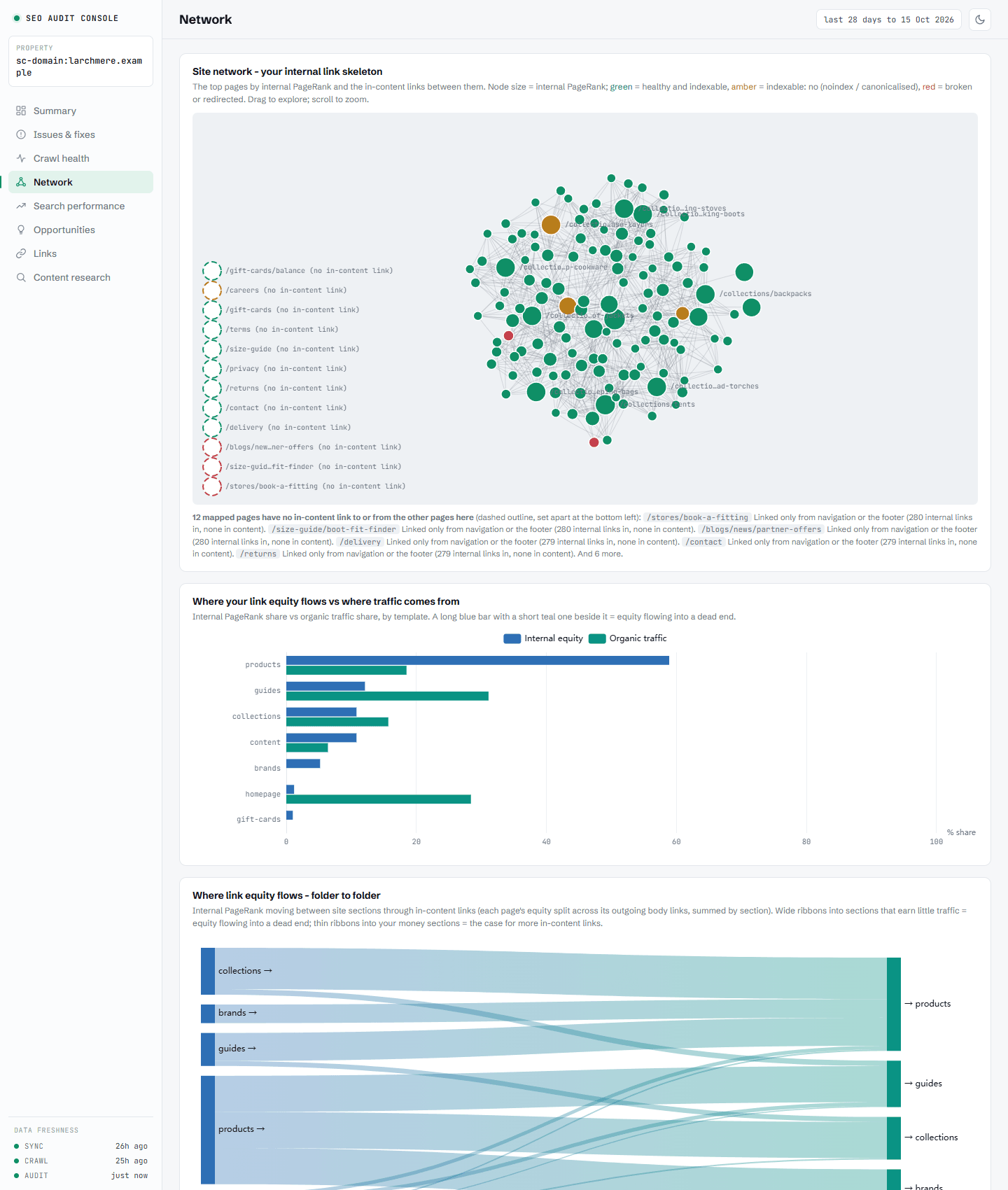
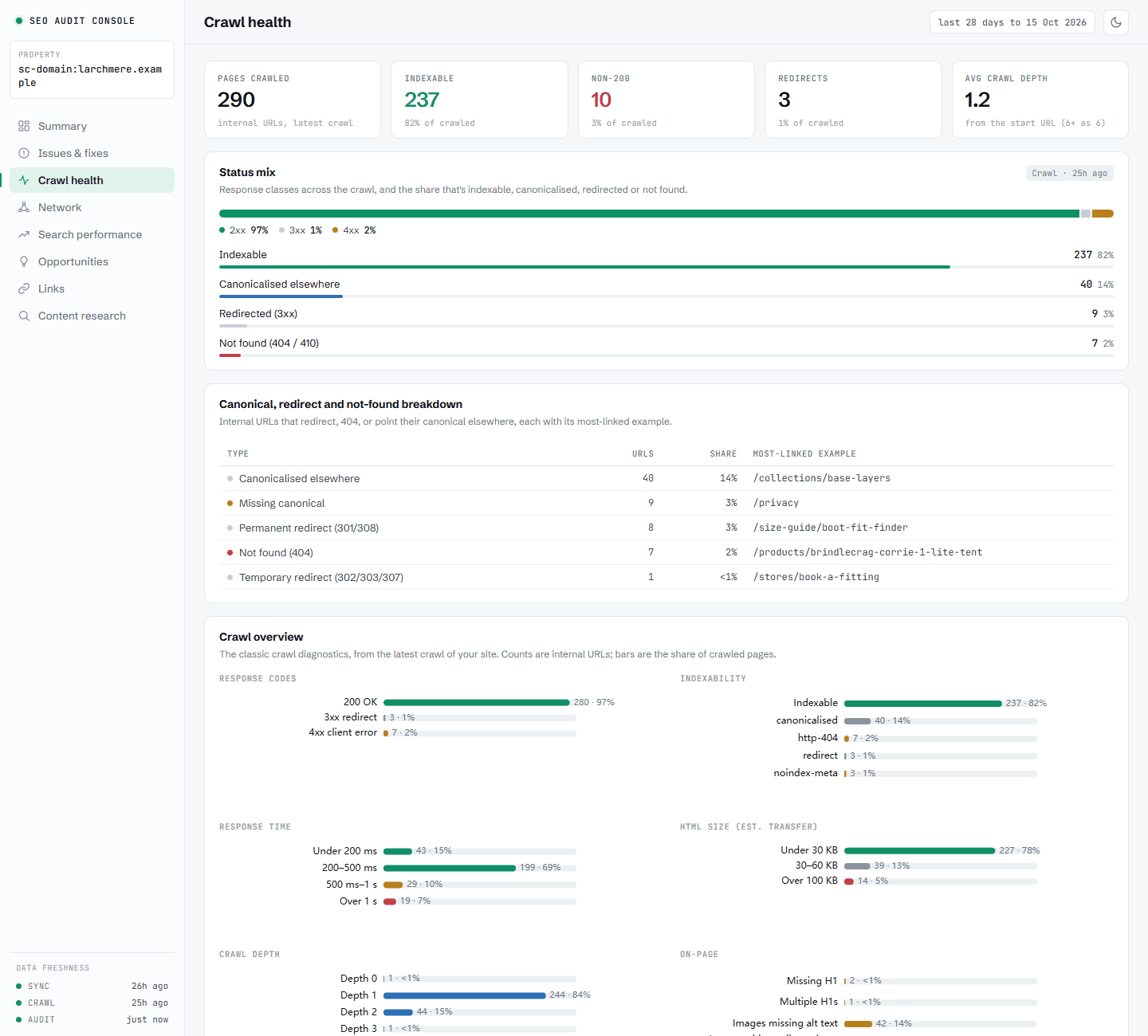
And if you grew up on the classic desktop SEO crawlers, the dashboard’s Crawl health tab will feel like home - response codes, indexability reasons, crawl depth, the heaviest images, server errors and slow pages, all as clean stat bars. Same diagnostics, except each one is sitting next to the Search Console numbers for the same URL. The tab-by-tab tour is in dashboard.md.
The crawl, properly explained
The crawl is where audits usually go wrong, so it’s worth understanding what this one does differently. I’ve spent enough of my career cleaning up after crawlers that fooled themselves. This one is a proper SEO crawler - it just happens to have your Search Console history sitting next to it.
It discovers pages three ways. Following links, reading your XML sitemaps, and - the important one - starting from every URL Google is already sending traffic to, straight out of your GSC data. Coverage stops depending on your sitemap being honest. It’s also exactly how ghost pages get caught: if Google ranks a URL your own site structure can’t reach, that URL still gets crawled, and the mismatch becomes a finding.
It records why, not just what. For every URL that isn’t indexable it stores the reason - 404, noindex, X-Robots header, canonicalised elsewhere, robots-blocked, non-HTML. “This page won’t rank” is a fact; “this page won’t rank because a plugin set an X-Robots header nobody remembers” is a fix.
It refuses to be fooled. A redirect that leaves your site (Shopify OAuth flows, I’m looking at you) is recorded as a redirect-out, never stored as a page. It always uses GET rather than HEAD, because a HEAD request can return a different status than the real request would - but it abandons the body for images, PDFs and assets, so it records status and size without downloading the bytes.
It’s quick without being rude. HTTP/2 where your origin supports it, gzip and brotli negotiated, keep-alive connections reused. The speed comes from efficiency, not from hammering your server. It respects robots.txt properly (a bot-specific group replaces *, per the spec, which plenty of commercial crawlers get wrong), and skips the junk: internal search, faceted filter combinations, login flows. This is a crawler for sites you own. Being a good guest is the point.
It slows down when your host asks it to. A 429 (or a 503 with Retry-After) halves the crawl’s concurrency, waits out the Retry-After, and puts the URL at the back of the queue for two more tries; clean responses add workers back. Shopify stores are spotted from their headers and start gently. A URL still rate limited at the end is stored as rate limited with no status, never as a broken page, and the crawl status tells you how many.
It tests what a crawl can’t find on its own. Each crawl ends with up to five site probes: two URLs that can’t exist (does the site answer 404, or 200 and a soft-404?) and the http/https and www/apex twins of the homepage and a deep page (one 301 to the canonical host, or a split?). It also records what every page loads - stylesheets, scripts, fonts, images, first or third party, in the head or the body - without downloading any of it; headResources:true adds a header-only pass for their status, size and caching.
It says what it didn’t measure. A check whose data was never collected - the asset checks before a headResources crawl, the render checks before render_pages, field Core Web Vitals before sync_crux - is listed in the audit as not collected, with the step that collects it. An empty table never reads as a clean bill of health.
After the crawl it computes a real link graph: internal PageRank with nav and footer links down-weighted, click depth from the homepage counting body links only, in-degree per page. That graph powers the orphan, equity-leak and underlinked-page checks - and the donor rankings when the tool suggests internal links.
The workflows, briefly
Each of these is a real procedure I use, and each is one prompt. The expanded versions, with what happens underneath, live in the manual pages linked.
- Your first audit. “Refresh sc-domain:mysite.com”, then “Run an SEO audit on mysite.com”. Twenty minutes on a mid-size site, and the top five findings are usually worth more than the other eighty-five combined. Then “generate the fix for #1”. → getting-started.md
- Sitewide keyword optimisation. The question isn’t “what keywords should I target?” - it’s “where does my copy fail to say what I already rank for?” “Score the passages on mysite.com” runs a small local relevance model over every ranking page; “draft the missing content for /page” writes the fix in your site’s own voice, grounded so it invents nothing. → tools.md
- Cannibalisation. “Show me the cannibalisation findings with evidence” - thresholds tuned so incidental long-tail overlap doesn’t count, so the consolidate-or-differentiate call is made on numbers. → checks.md
- The content plan. “Suggest new pages for mysite.com” mines demand Google already shows you; “what topics should mysite.com cover?” maps the demand it doesn’t. Together: a quarter’s plan. → competitive.md
- The template play. “List the page templates” - big sites aren’t 50,000 pages, they’re a dozen templates repeated, and one template fix corrects the whole cluster. → tools.md
- Monitoring and migrations. “Detect changes on mysite.com” diffs your two most recent crawls by severity. During a migration this is the difference between catching a stray noindex on Tuesday and explaining a traffic graph in a board meeting three weeks later. I’ve been on the wrong end of that one. → tools.md
- AI-search readiness. “Check agent readiness for mysite.com” - the web is quietly growing a second audience, and almost no SEO tool checks any of it. → tools.md
- Your own questions. The four datasets share three join keys, and the most valuable analyses are the ones you compose yourself - “which pages lost clicks after being cited in AI Overviews?” is one prompt here and a feature nowhere else. → composition.md
- Reporting. “Show me the dashboard” in the chat, “serve the dashboard” for the live version in your browser, or “export the report” as one self-contained HTML file you can send a client. → dashboard.md
- The content opportunity report. If you write for a living, this is your page one: “Content opportunities for mysite.com” returns what to WRITE next (demand you already earn impressions for with no winning page), what to REFRESH (pages bleeding clicks), which SNIPPETS to rewrite (ranking well, under-clicked), and which clusters to STRENGTHEN (position 4-20, one push from the money). Every row traces to your own Search Console data - no invented keyword ideas - and “draft the brief for row 1” turns any of them into a grounded outline. → competitive.md
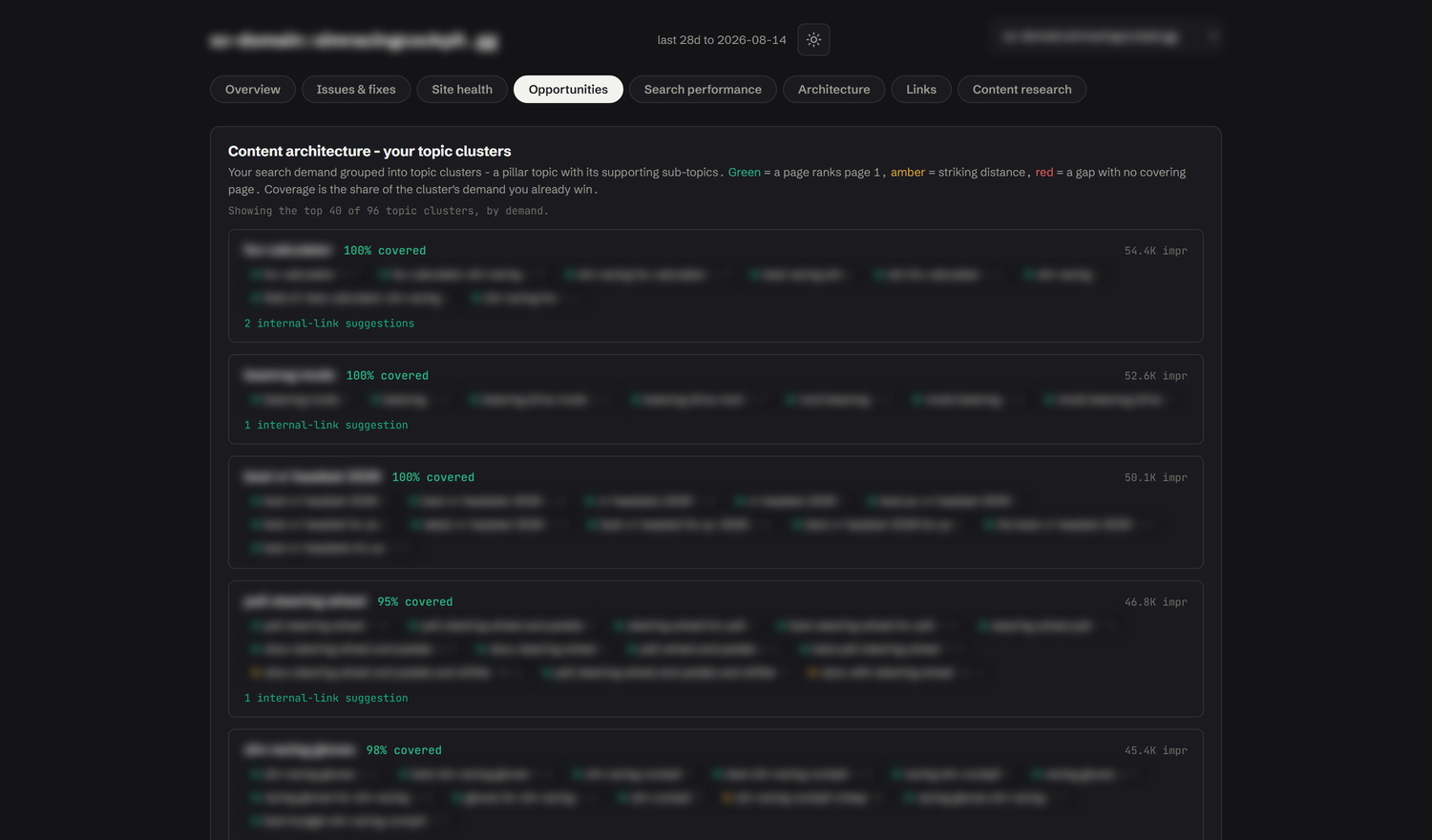
- Market Sizing and Prioritisation. “Size the market: mysite.com vs rival1.com and rival2.com” - the keyword universe, total monthly demand, and share of voice per topic cluster, from one cached call per domain. The engagement-opening read that used to need a Semrush subscription. → competitive.md
- Content recon - why is this page losing? “Run content recon on mysite.com” takes your highest-impression pages sitting at positions 3-15 (the ones a push could move), pulls the live Google SERP for each, and reads whether the AI Overview cites you. The verdict is the honest bit: rank but not cited is a data-accuracy or freshness problem, not a rewrite. It reads the reachable competitors with a free browser-profile fetch (Reddit through its own JSON), lists the ranking videos for you to watch, and writes the gaps into a tracked to-do board you can annotate and re-measure. → recon.md
- Link prospecting, sorted by authority that’s real. “Link intersect for mysite.com vs rival1.com, rival2.com” returns the domains linking to your rivals and not to you - the outreach list, followed-first and spam-filtered. Add a Majestic key and it re-sorts on Trust Flow and shows each prospect’s Topical Trust Flow, so the directories drop out and what’s left is authority that’s on your topic. → Majestic, below
What DataForSEO adds (and what it costs)
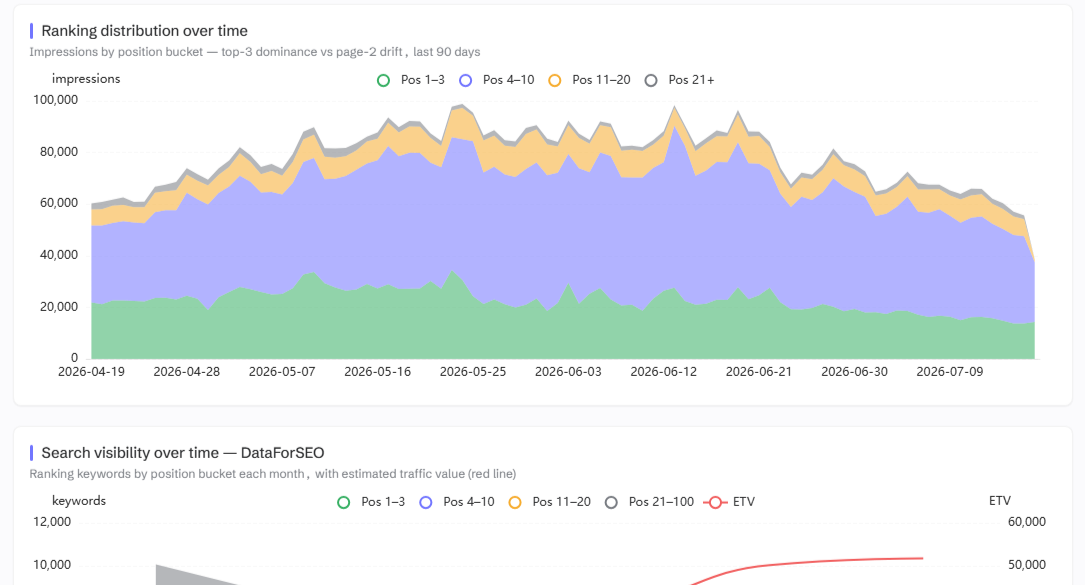
Everything above works with just your Search Console data. But GSC can only describe searches where you already appear. The moment your question is “how big is this market?” or “what do competitors rank for that I don’t?”, you need third-party data - and that’s DataForSEO: a pay-as-you-go API for volumes, live rankings, competitor data and Lighthouse runs. No subscription; calls cost fractions of a cent to a few cents, cached for 20 days, and only ever run when you ask. My own usage runs to a few dollars a month.
It unlocks the Semrush-replacement layer: the organic visibility overview for any domain, any site’s top pages and ranked keywords (including which of them show an AI Overview), the content gap, topic gaps, search intent, lab Core Web Vitals and backlinks. It also drives content recon - recon_targets pulls the live Google SERP for a losing page, reads whether the AI Overview cites you, and tells you why you’re behind. The full workflows and setup: competitive.md.
One more thing DataForSEO unlocks gets a section of its own, because the link work has a second, optional service behind it.
Link intersect, and the Majestic Trust Flow tier
Link building is the one discipline where the prospect list is the strategy, so link_intersect builds it from evidence rather than a hunch. One DataForSEO domain_intersection call over your competitor set - yours excluded - returns every domain that links to them and not to you, aggregated per prospect: how many of your rivals it links to, whether the link is followed, its worst spam score, the anchor mix. Point it at a single company instead of a set and it answers the other classic, what links does company X have that we don’t?
That gets you a list. It doesn’t get you a priority order, and this is where link prospecting has always gone wrong. DataForSEO sorts on domain rank, which is a link-volume metric, so directories, aggregators and syndicated-press domains float straight to the top - technically authoritative, worthless to pitch. Every link builder I know has lost a week to that list.
Set MAJESTIC_API_KEY and the order changes to one you can defend. Majestic has been crawling and scoring the web’s link graph since before most of today’s SEO tools existed, and its two flagship metrics are exactly the ones that fix this:
- Trust Flow (0-100) - editorial authority, propagated from a seed set of trusted sites. It measures who vouches for a domain rather than how many links it has managed to accumulate. That’s the directory killer: in testing, a domain DataForSEO ranked 227 came back Trust Flow 0. A volume metric simply cannot see that.
- Topical Trust Flow - what that authority is about, as ranked topics. A Trust Flow 45 domain is a brilliant link when its top topic is
Recreation/Autosand you sell car parts, and a wasted pitch when it’sHealth/Nutrition. It’s the difference between a strong link and a relevant one, and it’s the column that makes an outreach list survive contact with a client.
With the key set, every qualifying prospect is enriched, the table gains a Trust Flow column and each domain’s leading topic, and the whole list is re-sorted by Trust Flow:
you  › link intersect for mysite.com vs rival1.com, rival2.com

     Prospect domain     Links to  Trust Flow  Link    Spam  Backlinks  Top topic
     enthusiast-mag.com  2/2       54          follow  2     31         Recreation/Autos
     club-forum.org      2/2       41          follow  0     12         Recreation/Autos
     free-link-list.net  2/2       0           follow  28    904        –
(Shape of the output, names invented.) Same three prospects, same DataForSEO data underneath - and note which one has the most backlinks. Sorted DataForSEO’s way, the directory is the one you’d have emailed first.
link_intersect needs DataForSEO’s Backlinks subscription, which is separate from their SERP/Keywords/Labs APIs; if it isn’t activated the tool says so in plain English rather than throwing a code at you.
The tier is careful with your allowance: enrichment is batched 100 domains per call (about one unit each), capped by enrichLimit (default 100 - and when more prospects qualify than get enriched, the response says so and tells you to raise it, rather than handing you a half-scored list), requests are serialised, and every response is cached for 30 days via MAJESTIC_CACHE_DAYS. Ask the same question twice in a fortnight and the second answer costs nothing.
Optional, and I mean optional: with no key, link_intersect still runs and still sorts followed-first by domain trust. Majestic is what turns “here are 100 domains” into “here are the 20 worth an email, and here’s why”. Grab a key on their plans and pricing page; the full workflow is in competitive.md.
Trust Flow and Topical Trust Flow are trademarks of Majestic (Majestic-12 Ltd). This tier calls the Majestic API with your own key, only when you run
link_intersectorpull_backlinks(which adds Trust Flow to your own backlinked pages for the dashboard’s Trapped authority report), and nothing else in the tool touches it.
Installation, in brief
Three steps - the quick start above is the short version, and the full walkthrough with the gotchas is getting-started.md:
- Get it: the quick route is npx - point your MCP config at
npx -y @houtini/seo-audit-consoleand there’s nothing to build. Or clone this repo,npm install,npm run buildif you want the source. Either way, Node ≥ 20. - Connect Search Console: create a Google Cloud service account, download its JSON key, and - the step everyone misses - add the service account’s email as a user on your property in Search Console. Prefer a walkthrough with pictures? Setting it up from scratch covers the whole flow.
- Point your MCP client at it with
GOOGLE_APPLICATION_CREDENTIALSset:npx -y @houtini/seo-audit-consolefor the published package, ornode /path/to/seo-audit-console/dist/index.jsif you built from source. Works in Claude Desktop and Claude Code; only the one env var is required.
Every environment variable the server reads, in one block. The first is required and everything below it is optional: fill in the ones you use and leave the rest as empty strings (or delete them). An empty value switches that service off, and so does leftover template text such as your-key-here (with one line in the server’s log saying so).
{
  "mcpServers": {
    "seo-audit-console": {
      "command": "npx",
      "args": ["-y", "@houtini/seo-audit-console"],
      "env": {
        "GOOGLE_APPLICATION_CREDENTIALS": "C:/path/to/service-account.json",
        "SAC_DATA_DIR": "",
        "DATAFORSEO_USERNAME": "",
        "DATAFORSEO_PASSWORD": "",
        "DATAFORSEO_CACHE_DAYS": "20",
        "MAJESTIC_API_KEY": "",
        "MAJESTIC_CACHE_DAYS": "30",
        "CRUX_API_KEY": ""
      }
    }
  }
}
Built from source instead? Swap the two launch lines for "command": "node" and "args": ["C:/path/to/seo-audit-console/dist/index.js"]; the env block is identical.
GOOGLE_APPLICATION_CREDENTIALS gets you the whole core audit. DataForSEO adds the market layer, MAJESTIC_API_KEY adds the Trust Flow re-sort to link_intersect, and CRUX_API_KEY (optional: field Core Web Vitals, a free Google API key restricted to the Chrome UX Report API) adds real-user LCP, INP and CLS. Line-by-line, including the advanced ones you’ll probably never need (the reranker device, the Majestic sandbox host, and the dashboard server’s bind, port and auto-start): getting-started.md.
Then: “list properties” to check it’s connected, “refresh”, “run an SEO audit”.
Upgrading to 0.16.0
0.16.0 changes how Search Console rows are stored. The device and country rows a segments:true sync pulls now live in their own table (search_analytics_segments), and search_analytics holds only the all-country totals, so no total can count a day twice. Nothing to do by hand, but know what the first sync after upgrading does to a database that held both shapes:
- It backs the database up first, to
.bak-beside it. The backup is a full copy, so a 5 GB database leaves a 5 GB.bakfile. - It checks free disk before it starts: room for the backup, plus half the database again, plus 256 MB. Without that room the migration waits: the sync still runs in the old layout (totals stay correct, because the views count each day once), the reply says “storage migration deferred: needs N GB free”, nothing is moved, and it migrates on a later sync once there’s space.
- Then it moves the rows, a batch of days at a time. On a 5.5 GB database that took under three and a half minutes, backup included. If it’s interrupted it carries on from where it stopped on the next sync, and the numbers read correctly throughout.
- Afterwards, reclaim the space. The database file keeps its size until it’s compacted: ask “vacuum the mysite.com database” (
data_storage,prunewithvacuum). On the 5.5 GB test database that took it to 4.4 GB. Once you’re happy with the numbers, delete the.bakfile yourself; nothing deletes it for you.
A database that only ever held one shape (most do: a sync without segments) is marked as migrated on first open, with no backup and no move. The changelog has the rest of the release.
Docker and the Docker MCP gateway
Crawls, syncs and refreshes run as background jobs: the tool returns a job id at once and the work carries on while you poll check_crawl_status. Run normally (npx, or node dist/index.js from Claude Desktop), the server process is long-lived and does that work itself. Nothing below applies.
The Docker MCP gateway is different. It runs the server in a worker container per client connection, and it replaces workers freely: on disconnect, on a router recreate, when it reaps idle ones. A job running inside a worker dies with it. The fix is to move the work out of the worker into one long-running job runner container that the gateway never touches:
- the MCP server, started with
SAC_JOB_RUNNER=external, only queues each job in_jobs.dbin the data directory and reads its status; - the runner (
seo-audit-runner, in the same npm package) claims queued jobs, runs them and writes progress back to the same database.
The workers become disposable: recreate the router mid-crawl and the crawl carries on in the runner.
1. Start the runner on the same data volume, with the same credentials as the gateway’s catalog entry:
docker run -d --init --name seo-audit-runner --restart unless-stopped \
  -v mcp-sac-data:/data -v mcp-sac-creds:/creds:ro \
  -e SAC_DATA_DIR=/data -e GOOGLE_APPLICATION_CREDENTIALS=/creds/gsc.json \
  -e DATAFORSEO_USERNAME -e DATAFORSEO_PASSWORD -e MAJESTIC_API_KEY -e CRUX_API_KEY \
  node:22-slim npx -y -p @houtini/seo-audit-console seo-audit-runner
The four -e NAME flags with no value pass those variables through from your shell, so the keys stay out of the command line; leave out any you don’t use. On Windows in Git Bash, prefix the command with MSYS_NO_PATHCONV=1, otherwise MSYS rewrites /data and /creds into Windows paths (PowerShell doesn’t need it). --init makes docker stop reach the runner as a clean SIGTERM. The first start takes about a minute while npx installs the package; docker logs seo-audit-runner shows it start and every job it claims.
2. Switch the gateway to queueing. Add SAC_JOB_RUNNER=external to the env of this server’s catalog entry, and remove longLived: true (it was only ever a stopgap for this).
What you’ll see. A job reads queued: waiting for the job runner until the runner picks it up, then running as before. If a job stays queued for over a minute and no runner has checked in, the status says so and prints the docker run line above. After about two minutes with no runner heartbeat it reads queued (no runner) and no longer blocks data_storage prune or repair; it stays listed until the usual one-day prune. One runner runs one job at a time by default; set SAC_RUNNER_CONCURRENCY to run more, though two jobs for the same property never run at once. To update, recreate the runner container (docker rm -f seo-audit-runner, then the docker run line again, so npx installs the new release; a plain docker restart can keep running the copy npx already installed in the container). Keep the runner and the gateway on the same release: pin @houtini/seo-audit-console@ in both if you want updates to be deliberate. A job running when the runner stops is recorded as interrupted, so re-run it.
The first call after a worker starts is slow. Each gateway worker is a fresh container, and npx installs the package before the server can answer: about 60 seconds on a cold npm cache. That can outlast the client’s tool-call timeout, and a client that retries can start extra workers, each installing again. Two ways round it:
-
Pin the version in the catalog entry’s command (
npx -y -p @houtini/[email protected] ...rather than the bare name), so npx never has to look up “latest”, and the runner and the server stay on the same release. If the entry mounts a named volume at/root/.npm(the npm cache), pre-warm it once after each upgrade, so workers start from a warm cache:docker run --rm -v sac-npm-cache:/root/.npm node:22-slim npx -y -p @houtini/[email protected] node -e 0 -
Or build a small image with the package preinstalled and point the catalog entry at it. Workers then start in a second or two:
FROM node:22-slim
RUN npm install -g @houtini/[email protected]
ENTRYPOINT ["seo-audit-console"]
docker build -t seo-audit-console:0.16.1 ., then use that image (the runner runs from it too, with--entrypoint seo-audit-runner). Rebuild it for each release.
After upgrading, restart the MCP client. Clients read the tool list once, when they connect, and keep it. Until Claude Desktop or Claude Code is restarted (fully, from the tray on Windows), tools added in the new release, such as sync_crux, stay invisible even though the server has them.
Without the runner, the older options still work: longLived: true on the catalog entry (or --long-lived on the gateway), or plain docker run -i --rm with the volumes mounted, which is one long-lived stdio process for the session. Either way, mount named volumes for the data directory and the credentials (for example -v seo-audit-data:/data -e SAC_DATA_DIR=/data and -v seo-audit-creds:/creds:ro -e GOOGLE_APPLICATION_CREDENTIALS=/creds/service-account.json) so audits and the job list survive a restart.
There’s no published image for the server itself: build one from this repo’s Dockerfile (docker build -t seo-audit-console .). Its entrypoint is node dist/index.js, the stdio server.
Every job is recorded in _jobs.db in the data directory. If the process running a job exits before it finishes, the job reads as interrupted with the reason rather than disappearing, and a finished job’s result can still be read after a restart.
The gateway doesn’t publish the server container’s ports, so the browser dashboard the server starts after a job isn’t reachable from your machine. The server notices it is in a container without a published dashboard port (no SAC_DASHBOARD_BIND=0.0.0.0 with SAC_DASHBOARD_PORT), and says so in place of the link, with the command to start the standalone dashboard. get_dashboard still renders it in chat, and for a browser tab you can run the standalone dashboard, seo-audit-dashboard, as a second container on the same data volume with a published port. The command is in dashboard.md.
The tools, at a glance
The one-line version - full descriptions, inputs and example prompts for every tool are in the tool reference.
| Tool | What it does |
|---|---|
refresh_property |
Sync GSC + crawl + inspect + rank history + CrUX field data, one job |
sync_gsc · start_crawl · inspect_urls · track_ranks · sync_crux |
Run a single part on its own (sync_crux: real-user Core Web Vitals from the Chrome UX Report, free with a CRUX_API_KEY) |
check_sync_status · check_crawl_status |
Watch a long job’s progress |
run_audit · query_audit · list_checks |
The scored audit · one check with evidence · the catalogue |
query_data |
Read-only queries over the raw tables - aggregates in the database, answers not rows |
open_dashboard |
The property’s live browser dashboard link; finished syncs and crawls offer it themselves |
probe_urls · triage_404s |
Test any URL live (redirects, canonical, cache, case/slash/host variants) · the 404 list as a redirect map |
fix_finding |
Paste-ready remediation (JSON-LD / 301 / internal links) |
detect_changes |
What changed between the two most recent crawls |
check_agent_readiness |
0-100 AI-agent readiness score with copy-paste fixes |
list_templates · suggest_pages |
Template clusters · new-page ideas from real demand |
score_passages · draft_content |
Local relevance scoring · grounded writing briefs |
find_duplicates · render_pages |
Semantic near-duplicate pages (local model) · Response vs Render in headless Chromium (optional Playwright) |
resolve_entities |
Wikidata entities and the link gaps between them |
keyword_volume · related_terms · search_intent |
DataForSEO keyword data |
youtube_discovery · news_discovery · topic_trend · trend_categories |
Content research: the videos ranking for a topic (pair with a transcript tool) · recent news coverage / freshness · Google Trends interest-over-time for keywords, a whole category, or a term inside one (rising / falling / seasonal, plus breakout topics and queries) · free lookup of the Trends category codes |
competitors_domain · page_intersection · topic_gaps |
Competitors · content gap · topic gaps |
domain_visibility · top_pages · ranked_keywords |
The Semrush-style views, any domain (+ aioOnly for the keywords that show an AI Overview) |
page_lighthouse · pull_backlinks |
Lab CWV · backlink profile with live status |
link_intersect |
The links your competitors have that you don’t - a prioritised outreach list (followed-first, sorted by domain trust; optional Majestic Trust Flow re-sort kills directory noise) |
market_sizing · serp_features |
Share of voice vs named competitors · AI-Overview / snippet / video exposure by volume |
keyword_list · content_opportunities |
Cluster a keyword list (own / weak / absent) · the content marketer’s report |
recon_targets · save_recon_todo · recon_todos |
Content recon: why a page is losing (live SERP + AI Overview) → a tracked, annotatable to-do board |
get_dashboard · serve_dashboard · export_report |
In-chat dashboard · the same in a local browser tab · shareable HTML |
get_dashboard_data |
Internal: the dashboard widget fetches its data through this; not for direct use |
composition_cookbook |
The data-surface map and recipes for bespoke analyses |
data_storage |
Per-property disk usage and row counts, confirm-gated pruning, and an integrity check with index repair |
normalize_url · data_location · list_properties · seo_audit_help |
Utilities and the help menu |
How it works under the hood
- The join key (
url_key). GSCpageand crawlurlboth normalise down to the same key - force HTTPS, unify www and apex, strip tracking params, and so on. Everything joins on that. It’s the whole trick, really. - One SQLite database per property (WAL, prepared statements). Your data stays on your machine.
- Scored once, sorted by yield.
(expected clicks × yield × certainty) / effort. Covering-indexed, so the audit stays fast even when the GSC table runs to millions of rows. - Careful with your history. Crawls and syncs never destroy the previous snapshot until new data has started arriving - a site outage mid-crawl doesn’t cost you your data.
- Owned-site only, dry-run fixes. It crawls sites you control, and the generators return artifacts. They never write to your site. That’s a line I won’t cross.
Privacy and data
Your Search Console data and the crawl live in local SQLite files under SAC_DATA_DIR. The passage-scoring model runs locally too. Nothing leaves your machine except the API calls you trigger - Google (your own GSC, and the Chrome UX Report if you’ve set CRUX_API_KEY: it’s sent your origin and top page URLs) and, if you’ve set them up, DataForSEO and Majestic (link_intersect sends prospect domain names; pull_backlinks sends your own backlinked page URLs). Every one of those is keyed by you, called on demand, and cached locally so it isn’t called twice. Content recon’s competitor fetch requests those public pages directly, with no service in between. The crawl also reaches beyond your own site in one way: after each crawl it checks the outbound links your pages carry (a HEAD request, or a ranged GET, to each linked URL; checkExternal:false turns that off). And the free extras fetch from public sources: the local models download once from Hugging Face, resolve_entities queries Wikidata, and news_discovery reads the Google News feed. No telemetry. None.
What’s coming
A few things I’m building next, in rough order:
- Structured-data opportunities, by template. Not “you have no schema” (most modern stores have plenty), but “this template could earn review stars or an FAQ rich result and doesn’t.”
- A per-page content scorecard. A dedicated table of every ranking phrase your copy misses, not just the top query.
- More agent readiness. A WebMCP advisory (which tool actions your site could expose to agents) and the agent-commerce protocols.
- A printable report. A proper A4 document you can hand a client, not a slide deck.
- Source-level parser checks. The layer most tools never touch: elements that silently break `` parsing, and directives hoisted into the body and ignored. (Raw-vs-rendered divergence now ships - see JavaScript rendering above.)
Got a weird edge case you wish a tool caught? Tell me - that’s exactly how the merged GSC×crawl checks got built.
About Houtini
Houtini exists for one reason: the hours your team loses to grunt work. Pulling Search Console exports, running crawls, cross-referencing spreadsheets, re-checking what changed since last month - none of it needs a person, and all of it eats the time your people should be spending on strategy, on clients, on the work that moves numbers. So we automate exactly that layer. SEO Audit Console is one of a family of tools built on the same principle - if a machine can collect it, merge it and check it, a machine should.
Questions, licensing, or something you’d like automated: [email protected]
Credits
SEO Audit Console stands on a few third-party services - all optional except your own Search Console access, and each called only with a key you provide:
- Google Search Console - your own search-performance history (the one required credential).
- DataForSEO - SERP, keyword, Labs and backlink data: keyword volumes, competitor footprints, rank history, and the
link_intersectdomain intersection. Pay-as-you-go, optional. - Majestic - Trust Flow and Topical Trust Flow for the
link_intersectenrichment tier, which re-sorts link prospects by real editorial authority. Trust Flow and Topical Trust Flow are trademarks of Majestic (Majestic-12 Ltd). Optional; get a key on their plans page.
Built with better-sqlite3, cheerio, Apache ECharts, and a local ms-marco cross-encoder (via Transformers.js) for on-device passage scoring - no data leaves your machine for that.
Contributing
Issues and PRs welcome. The check registry (src/audit/checks.ts) is built to be extended - each check is a pure read over the joined data that returns findings with evidence, so adding one is fairly self-contained. There’s an end-to-end smoke test (npm run smoke) and per-feature probes (npm run probe:*) to keep you honest. By submitting a PR you agree your contribution is licensed under the project’s LICENSE (Apache-2.0).
License
Apache License 2.0. Free to use, modify, and redistribute, including commercially - full terms in LICENSE.
Install
npx -y @houtini/seo-audit-consoleConfiguration
{
  "mcpServers": {
    "seo-audit-console": {
      "command": "npx",
      "args": ["-y", "@houtini/seo-audit-console"],
      "env": {
        "GOOGLE_APPLICATION_CREDENTIALS": "C:/path/to/service-account.json",
        "DATAFORSEO_USERNAME": "",
        "DATAFORSEO_PASSWORD": "",
        "MAJESTIC_API_KEY": "",
        "CRUX_API_KEY": ""
      }
    }
  }
}